
Sambor Preikuk
Overview
Sambor Prei Kuk
Located on the Eastern bank of the Tonle Sap lake, close to the Steung Saen River, the central part of Sambor Prei Kuk is divided into three main groups. Each group has a square layout surrounded by a brick wall. The structures of the overall archaeological area were constructed at variable times: the southern and north groups (7th century) by Isanavarman I, who is considered a possible founder of the city and the central group (later date). The buildings of Sambor Prei Kuk are characteristic of the Pre-Angkorean period with a simple external plan. The principal material is brick, but sandstone is also used for certain structures. Architectural features include numerous prasats, octagonal towers, shiva lingams and yonis, ponds and reservoirs, and lion sculptures. Sambor Prei Kuk is located amidst mature sub-tropical forests with limited undergrowth. The area has been mined and could still contain unexploded ordnance.
Clusters
The whole compound is made of three clusters classified as group C for Central, N for North and S for South (Michon & Kalay, 2012).[citation needed] They are enclosed in a double-walled encircling 1,000 acre in which there were 150 Hindu temples today mostly in ruins.
Group N: Prasat Sambor is considered the main temple and it dates from the 7th century. It was dedicated to one of the reincarnations of Shiva known as Gambhireshvara (from Sanskrit – gambhir, profound, deep, solemn – and , shvara, Shiva, Śiva, The Auspicious One).
Group S: Prasat Yeah Puon includes 22 sanctuaries dated from the 7th century (600 – 635 AD) during the reign of Isanavarman I in dedication to Shiva.
Group C: It is occupied by the Central Sanctuary or Prasat Boram (ប្រាសាទបុរាម) with lion sculptures that had inspired the popular name of Prasat Tao (The Lions’ Temple). It is, however, the newest group dating the 9th century. The other main feature is the Tower of Ashram Issey, but there were also other constructions (18 temples) now in ruined.
History
7th century
Isanavarman I reigned over the Chenla Kingdom between 616 and 637 AD, taking Isanapura as his capital[9] and it is argued that he built the main temple Prasat Sambor (Group N), as there is an inscription on the site attributed to his reign and dated 13 September 627 AD.[10] The king is also known for sending his first embassy to the court of the Sui dynasty in China (616-617). Chenla conquered different principalities in the Northwest of Cambodia after the end of the Chinese reign period (i. e. after 31 January 656), which previously (in 638/39) paid tribute to China.[11] An inscription dating from the reign of Isanarvarman I claimed that he was, “the King of Kings, who rules over Suvarnabhumi”.[12] Vong Sotheara, of the Royal University of Phnom Penh, claimed that the inscription would “prove that Suvarnabhumi was the Khmer Empire.”
The last important king in Isanapura was Jayavarman I, whose death caused turmoil to the kingdom at the start of the 8th century, breaking it in many principalities and opening the way to a new time: Angkor. This site is also claimed as an early capital of Jayavarman II (O’Reilly & Jacques, 1990).
20th century
After the Lon Nol’s coup d’état to Prince Norodom Sihanouk in 1970, US President Richard Nixon ordered a secret bombing of Cambodia to fight the Khmer Rouge guerrillas and any influence of North Vietnam in the country. The US aircraft bombed positions inside the archaeological site, causing craters near the temples, while the guerrillas left several mines on the land that were cleared only in 2008.
Similar Experiences
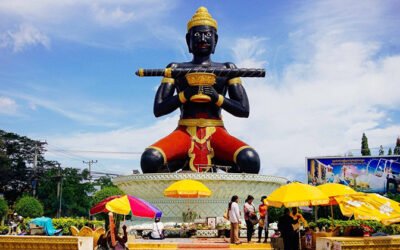
Battambang
Battambang is a province of Cambodia in the far northwest of the country. Bordering provinces are...
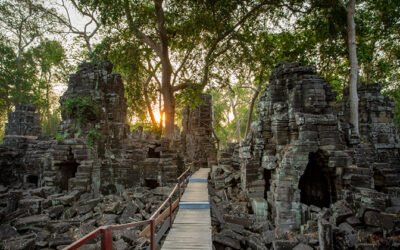
Banteay Chhmar
Banteay Chhmar is an urban centre from the Angkorian period, situated in the northwest Cambodian...
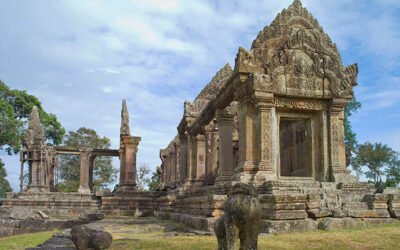
Preah Vihear
Preah VihearAs a key edifice of the empire's spiritual life, Preah Vihear was supported and...
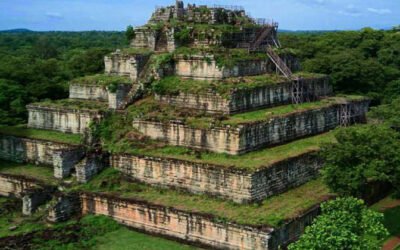
Koh Ker
Koh Ker is a remote archaeological site in northern Cambodia about 120 kilometres (75 mi) away...